
AI at the Substation Edge: Digital Twins and Predictive Maintenance for Transformers and Switchgear

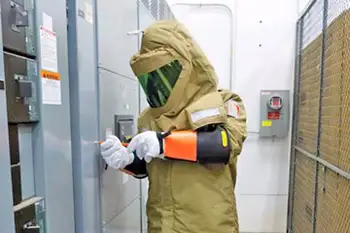
CSA Z462 Arc Flash Training – Electrical Safety Compliance Course
Our customized live online or in‑person group training can be delivered to your staff at your location.
- Live Online
- 6 hours Instructor-led
- Group Training Available
From Data Collection to Insight
Modern substations generate vast amounts of data—temperatures, gas levels, vibrations, contact wear, and breaker operations. Historically, much of it went unused. Now, with advances in edge computing and AI, that data can be analyzed in real time to forecast failures before they happen.
A digital twin models the behavior of a physical asset, updating continuously with sensor input. When combined with machine-learning algorithms, it becomes a powerful tool for predictive maintenance.
How Predictive Maintenance Works
AI systems learn normal operating patterns from historical data and flag deviations that may signal early degradation. This approach replaces fixed maintenance intervals with condition-based action, saving time and resources.
Key applications include:
- Transformer oil-gas analysis for insulation breakdown detection.
- Circuit-breaker wear prediction using contact resistance and operation counts.
- Partial-discharge pattern recognition in cables and bushings.
- Thermal-imaging analytics for hotspot detection in switchgear.
Each insight allows maintenance crews to intervene before a fault escalates into an outage.
Building the Architecture
Deploying AI at the substation edge involves several integrated layers. Data must be captured, cleaned, and interpreted close to the source to avoid latency and bandwidth limits. Edge processors or industrial servers host lightweight inference models that continue operating even when the network is down.
A typical architecture includes:
- Sensor Layer: Field devices collecting electrical and environmental parameters.
- Edge Processing: Local servers running analytics and generating health indices.
- Communication Layer: Secure links to central data platforms for training and trend analysis.
- Feedback Loop: Maintenance results feed back into model refinement.
This distributed design ensures continuous insight without dependence on cloud connectivity.
Implementation Challenges
Sign Up for Electricity Forum’s Newsletter
Stay informed with our FREE Newsletter — get the latest news, breakthrough technologies, and expert insights, delivered straight to your inbox.
Utilities exploring AI must confront practical hurdles: incomplete data histories, inconsistent sensor calibration, and limited staff expertise in data science. Moreover, models must be explainable—operators need to understand why an alert was raised, not just that it was. Establishing trust between engineers and algorithms takes time and transparency.
Read the full article at:
https://online.electricity-today.com/electricity-today/q3-2025/